Bio-Process
Gas delivery, sterile atmosphere control, and process monitoring for biopharmaceutical manufacturing.
行业范围
Bio-Process
生物制药与生物工艺对气体纯度、无菌性和过程可追溯性有严格要求。我们的质量流量控制与气体分析产品,为发酵、细胞培养、层析纯化等环节提供精确的气体供给与气氛监控,支持生物工艺的规模化与合规化生产。
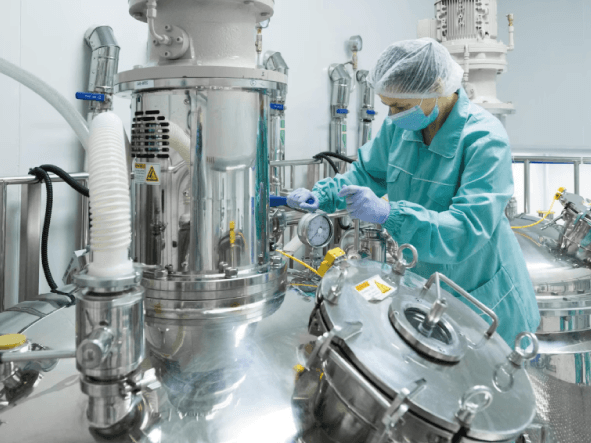
Biopharmaceutical fermentation and cell culture add sterility and process safety to already-tight gas-control requirements. A modern bioreactor gas system comprises source and pretreatment, mass flow controllers, a mixing manifold, a gas distributor, and a control system: compressed air, pure O₂, CO₂, and N₂ are pressure-reduced and sterile-filtered into individual MFCs, blended in the manifold, and injected through a sparger as microbubbles.
Dissolved oxygen (DO) is the core parameter. A DO probe senses culture oxygen; when it drifts off setpoint, the PLC uses PID to adjust the MFCs — changing the air/oxygen ratio or total aeration — to restore the target, often cascading DO with oxygen, air, and agitation.
CO₂ management is equally important: CO₂ can be sparged to control pH or create microaerophilic conditions, but dissolved CO₂ beyond a threshold inhibits high-density fermentation. In large vessels, hydrostatic pressure (up to hundreds of mbar at the bottom of a 10 m³ tank) lets metabolically produced CO₂ accumulate; a cascaded controller first reduces the CO₂ MFC opening, then raises the N₂ MFC flow to strip CO₂ from liquid to gas.
Sterility is a hard constraint: inlet gas passes 0.2 µm hydrophobic PTFE sterilizing filters, and pure-oxygen lines follow strict oil-free maintenance. MFCs need periodic calibration (typically every 6–12 months) and support multi-channel blending, cascade control, alarms, and interlocks.
HNR serves biopharma and fermentation with multi-channel gas blending, mass flow control, and process-gas monitoring that meet the precision and repeatability demands of DO/pCO₂ cascade control.